Choose the workshop question before choosing the meter

If you need a digital sound level meter for workshop checks, start with the CENTER-32 English-version offer only if your aim is preliminary readings and comparisons, not a complete exposure, legal nuisance or compliance assessment. Before ordering, confirm that the listing identifies the CENTER-32, the English-version SKU and the fact that its title claims IEC 61672-1 Class 2. During use, log the place, task, machine condition, time, duration and reading, then repeat the check under like-for-like conditions. If your decision depends on traceability or formal acceptance, pause and ask for the required documentation or seek competent specialist help.
That is the right starting point for a small-business owner, workshop manager, facilities worker or site supervisor responding to a noisy machine. The useful question is rarely just, “How loud is it?” You may instead need to know whether one work area is louder than another, whether closing a door changes the result, whether a machine sounds different after maintenance, or whether a complaint coincides with a particular task or operating period. A meter can support that preliminary conversation, but the value of the reading depends on the context recorded alongside it.
Set the UK workshop scene before taking a reading
At a joinery, metalworking, repair or packing bench, noise can change when a machine starts, stops, loads up or works on a different material. Doors, extraction, nearby tasks and the position of the person taking the reading can also affect what is observed. For that reason, do not walk into the workshop, capture one number and treat it as the answer. First identify the work area, the equipment involved and the concern being investigated. A clear question gives you a fairer basis for choosing measurement points and comparing results.
The person responsible should write down the operating condition before taking the first reading. Note whether the machine is idle, under normal load or completing a particularly noisy part of the process. Record the time and how long the activity continues, as well as whether other work is happening nearby. If a worker, neighbour or tenant raised the concern, record when they noticed it and what activity was taking place. This turns an impression into a preliminary record that can be discussed with management or used when deciding whether further assessment is needed.
Check the CENTER-32 English-version listing
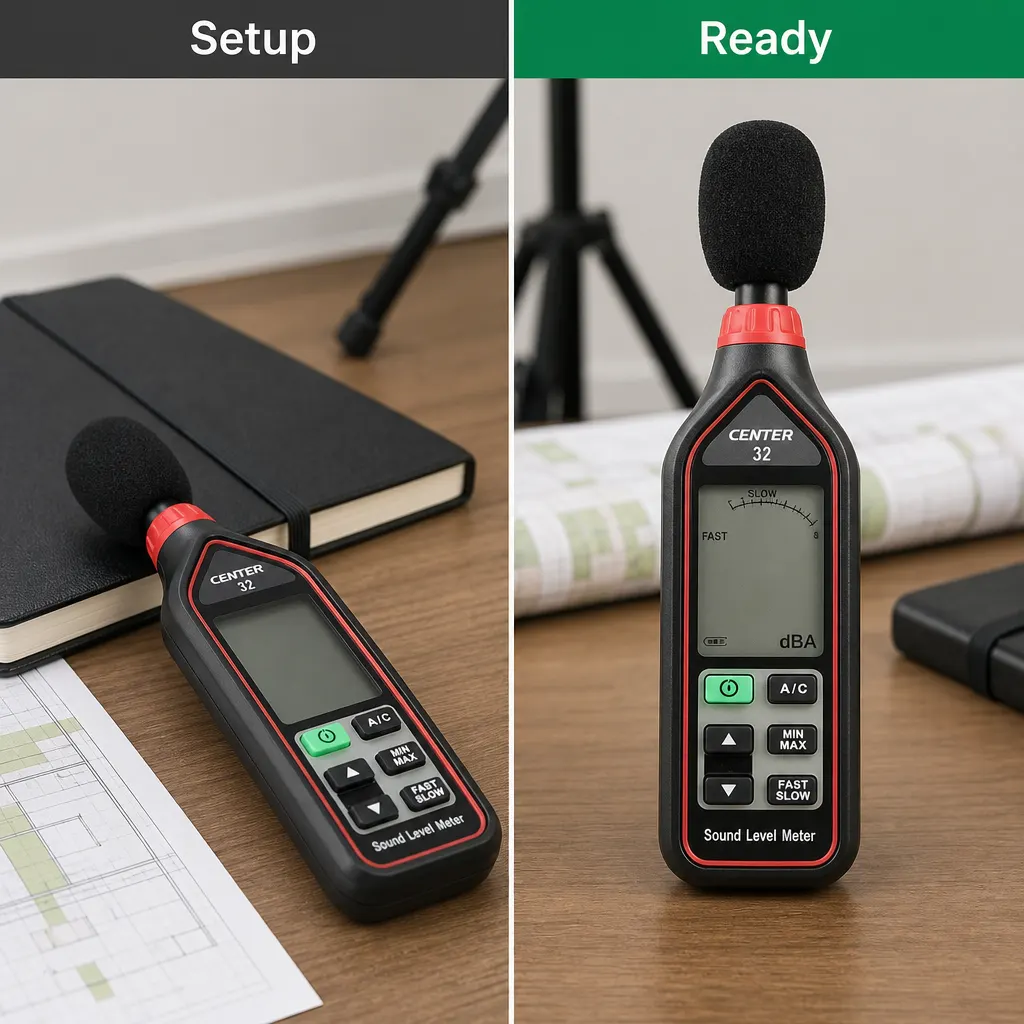
The documented offer is the CENTER-32 Digital Sound Level Meter, English Version, from CENTER/. The product information locks this article to the English-version SKU and excludes the Chinese-version SKU. That distinction matters when a purchase request, invoice or internal equipment list needs to match the item that was considered. The public product record is narrow: it does not provide dimensions, a detailed specification table, kit contents or usage steps. Do not fill those gaps with assumptions based on photographs, a similar model or an older marketplace listing.
The listed title claims IEC 61672-1 Class 2, but the supplied public record does not include independent supporting documentation for that claim. Treat the wording as a point to verify rather than as proof that the instrument will automatically be accepted for every purpose. Before relying on it for a formal report, ask the seller what documentation supports the exact English-version unit, whether calibration or traceability information is available and what operating guidance is supplied in English. Keep the answer with your purchasing records instead of relying on a copied product title.
Separate a spot reading from an exposure decision
A spot reading describes the sound observed at a particular place and moment. It does not, by itself, describe what a person experiences across a shift, how long a task continues or how often the noisy activity occurs. That distinction is central in a workshop, where one operator may remain beside a machine while another passes through the same area briefly. If the concern is personal exposure, record the worker’s task, position and duration as well as the meter reading. A preliminary number can identify a question, but it should not be presented as a complete Noise at Work assessment.
The same caution applies to neighbour complaints or disputes about working hours. A reading taken in the machine bay is not automatically evidence of what reaches a nearby home, boundary or shared building. Record the location, time, activity and conditions that produced it, and avoid presenting one result as legal proof of nuisance. If the issue may lead to enforcement, a client requirement, an occupational-health decision or a disagreement that needs defensible evidence, involve a competent professional and ask what measurement method and records are required.
Run a repeatable workshop walk-through
Use this sequence at a packing bench, machine bay or workshop doorway. First, write the question and select a small number of fixed locations. Second, record the machine, process, time, duration and operating condition before taking a reading. Third, observe each location consistently rather than moving around whenever the number changes. Fourth, repeat the observation when the same task and condition occur again, or after one control has been changed. Finally, compare the entries and mark anything that could have influenced the result. This sequence makes differences easier to explain without pretending that a short survey is a full assessment.
For the product check, use this plain-text checklist: identity—confirm the CENTER-32 English-version SKU; size—no dimensions or weight are documented, so check that before planning storage or carrying arrangements; surface and position—decide where readings will be taken, because no mounting or positioning method is stated; setup—no public usage steps are supplied, so request instructions; content—no kit contents are listed, so verify what arrives; environment—no operating limits are documented, so ask about the intended workshop conditions; aftercare—no maintenance or calibration details are provided, so obtain the information needed for your record-keeping process.
Spot the mismatch before you buy
The clearest mismatch is buying a meter for a decision that requires more than preliminary comparison. If your main requirement is a personal exposure assessment, a formal workplace report, evidence for a client or a defensible response to a legal dispute, do not assume that this offer alone answers the need. The listing identifies a digital sound level meter and includes a Class 2 claim in its title, but the supplied product record does not document the wider method, calibration status, traceability or acceptance criteria for your particular job.
There is also a practical mismatch if you expect a complete ready-to-use kit without checking first. Dimensions, specifications, included contents and operating steps are not set out in the public product information supplied here. That does not prove that the item lacks a particular accessory or document; it means you should not plan around one until it is confirmed. Buyers who need English instructions, a defined aftercare process or evidence to support an internal policy should make those requirements explicit before ordering rather than trying to resolve them after the meter arrives.
Compare the record needed for each workshop problem
For a preliminary machinery comparison, the key record is usually a consistent set of observations: the same machine, the same location, the same operating condition and a clear note of what changed between checks. The CENTER-32 English-version offer may be worth considering for that job if the documented identity and stated Class 2 claim meet your organisation’s requirements. For a worker concern, the record needs more context, including who was carrying out the task, where they stood and how long the activity lasted. The question changes, so the evidence needed changes with it.
For a neighbour complaint, location and timing may matter more than a reading taken beside the machine. For a formal assessment, the first step is to ask a competent professional what equipment, method and supporting records are needed. If you are comparing this meter with a phone app, compare the quality of the record and the documentation available for the intended purpose rather than assuming a technical accuracy difference that has not been evidenced. A simple comparison table in your notes can state the job, the required evidence, the gaps and the person responsible for the next decision.
Take the next documented step at the workshop
Before placing an order, write six questions against the product record: Is the exact item the CENTER-32 English-version SKU? Does the purchasing description repeat the English-version requirement? What documentation supports the IEC 61672-1 Class 2 wording in the listed title? Are dimensions and operating details available? What is included in the package? What information covers setup, calibration, maintenance or aftercare? If the seller cannot answer a question that affects your decision, record it as an unresolved gap. That is a stronger buying process than choosing from the title alone.
If the answers fit a preliminary workshop survey, define two or three locations and make a dated baseline under a clearly described machine condition. Keep the readings with the task, time, duration and environmental notes, then repeat the check after a specific change such as moving the task, altering a control or changing the operating method. If the pattern points to a worker-exposure risk, a persistent complaint or a decision requiring formal evidence, stop treating the meter as the final answer and seek competent advice. The next step is not simply buying an instrument; it is knowing what decision the record must support.