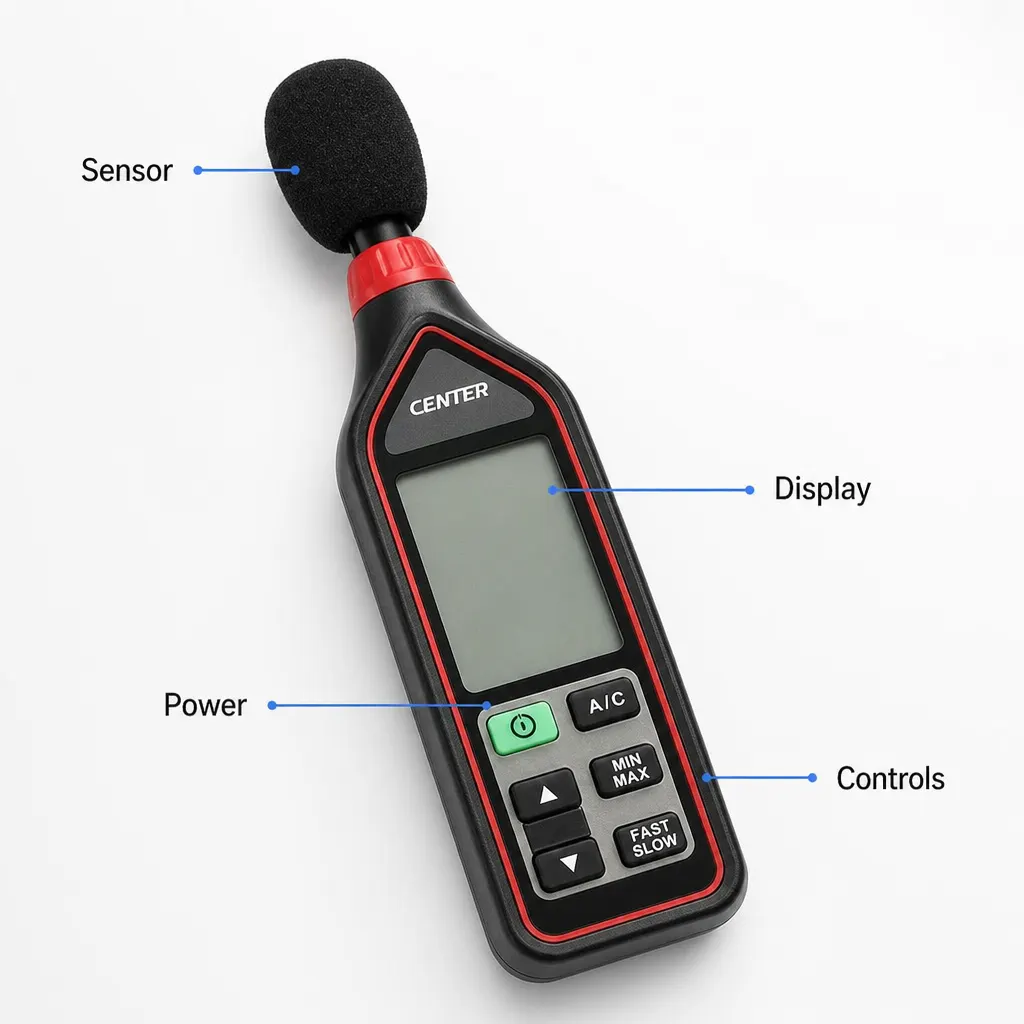
Start with a preliminary workplace noise check

If you need a sound level meter for workplace noise UK checks, begin by treating the reading as evidence for a preliminary comparison, not as a complete noise assessment. Before buying, confirm the exact CENTER-32 English-version SKU, note that the listed title claims IEC 61672-1 Class 2, and ask for supporting listed documentation if that claim matters to your records. At the workshop, take readings under a stated machine condition, location and time, then repeat the same setup for comparison. If the question concerns personal exposure, a complaint with legal consequences or formal compliance, pause and seek competent specialist advice rather than relying on one number.
That approach is intended for the person who has to make sense of a noisy work area without necessarily being an acoustician. A workshop manager might want to compare an extraction unit before and after a change; a facilities worker might need to check several rooms; a site supervisor might need a written record after a colleague raises a concern. The useful decision is not simply whether the display shows a high or low figure. It is whether the meter, the documented product information and the way you take readings are suitable for the question you are trying to answer.
Choose the UK work setting before choosing the meter
Name the setting first: a joinery workshop, engineering bay, packing bench, warehouse aisle, commercial kitchen or teaching workshop will each create a different measurement brief. Write down the source you want to examine, such as a machine, extraction system, compressor, process or group activity. Then decide whether you are comparing two locations, checking a change in working method, investigating a complaint or deciding whether existing controls deserve a closer look. This prevents a general request for a “noise reading” becoming an unclear exercise with no agreed purpose.
The operating context belongs beside the reading. Record whether the machine was running normally, under a particular load or during an unusual task, and note whether doors, enclosures or other relevant arrangements were in place. Include the location, date, time and approximate observation period in your record. If another person needs to understand the result later, they should be able to see what was happening when the reading was made. A number without its workplace setting can be difficult to compare and should not be presented as a complete answer about risk.
Check the documented CENTER-32 identity before buying
The product information supplied for this article identifies the item as the CENTER-32 Digital Sound Level Meter, English Version, from CENTER/. The offer is locked to the English-version SKU, and the Chinese-version SKU is specifically excluded. That language distinction matters when the buyer needs an instrument and operating information that match the description. Check the model name and version at the point of purchase rather than assuming that a similarly named listing is the same item. Keep a copy of the product description with your workplace records if the meter is being bought for a managed site.
The listed title states IEC 61672-1 Class 2 for this offer, but the supplied public product record does not include separate specifications, a certificate or independent supporting documentation. Treat that wording as a claim attached to the listing until the seller provides the documents you need to rely on it. Ask what documentation supports the claim for this exact CENTER-32 English-version unit, and whether any calibration or traceability information is available for your intended work. The absence of those details in the supplied record does not prove the meter lacks them; it means you should not fill the gap with assumptions.
Match the reading to the workplace question
A spot reading describes the sound observed at a particular place and time. It does not, by itself, describe what a person experienced across a working period, particularly when the work includes quiet intervals, changing tasks or movement between areas. This distinction is central when a manager is responding to a noisy machine or workplace complaint. A meter may help you identify where to look next and compare conditions, but the reading should remain labelled as preliminary unless the method and documentation meet the requirements of the assessment being undertaken.
For a before-and-after check, keep the comparison fair: use the same area, the same machine or process condition and a recorded time or observation period. If a door is closed, an enclosure is fitted or a task is moved, write that down rather than attributing any change to the equipment alone. For a neighbour or tenant complaint, record the activity and timing without presenting one reading as legal proof of nuisance. Context gives management, a contractor or a competent adviser something useful to review instead of a bare figure detached from events.
Follow a repeatable noise-reading sequence at the workshop
Use this six-point sequence as a working checklist. First, confirm that the instrument is the CENTER-32 English-version model. Second, write down the setting, such as the packing bench or machine bay, and the environmental conditions relevant to the comparison. Third, identify the activity or equipment operating at the time. Fourth, note the date, time and observation period. Fifth, record the displayed reading and any obvious change in the task. Sixth, retain the product description and your notes together, while marking any calibration, traceability or aftercare information as “to be confirmed” unless the seller has documented it. This gives a small-business buyer a consistent record without inventing product specifications.
Repeat the sequence when the question is comparative. For example, record the extraction unit running in its usual arrangement, then repeat the observation after a documented change; or compare the machine bay with the nearby packing bench while noting that the locations are different. Do not change several conditions at once if you want to understand what affected the result. If readings vary, keep the variation in the record rather than selecting the most convenient figure. A simple, honest log is more useful than false precision, especially when the public information for the meter does not state its range, controls, logging functions or supplied accessories.
Spot the mismatches before you buy
The CENTER-32 listing may be a mismatch if you need a complete occupational-noise exposure assessment, formal compliance evidence or a conclusion that must stand alone in a dispute. The supplied facts establish the model identity, English-version status and the Class 2 wording in the listed title; they do not establish that this particular purchase meets every requirement of your planned assessment. If your responsibility extends to personal exposure over a working period, ask a competent occupational-hygiene or acoustics professional what method and documentation are required before choosing an instrument.
It is also a mismatch if you need a documented feature that the public record does not confirm. The supplied information does not state the meter's dimensions, measurement range, settings, data-storage capability, power arrangement, kit contents, operating procedure or aftercare requirements. Do not infer those details from photographs, a similar model or a phone app comparison. A phone application might help someone understand whether an area changes from one condition to another, but the supplied product facts provide no accuracy comparison. Choose on the evidence available for your specific job, and request missing information before relying on the purchase.
Turn the first readings into a grounded next step
Once the walk-through is complete, look for a repeatable pattern rather than a single striking number. A consistent difference between two locations, operating conditions or control arrangements can show where a closer investigation should begin. If the result changes from one observation to the next, review the activity, timing and environment recorded beside each reading before drawing a conclusion. Share the log with the person responsible for the workplace and decide whether the next action is a change to the task, a further comparison or specialist advice. The meter should support that decision, not replace it.
Before placing an order, ask the seller to confirm the exact CENTER-32 English-version SKU, the documentation supporting the listed IEC 61672-1 Class 2 claim, the operating information supplied with the unit and any calibration or traceability details relevant to your purpose. The supplied offer lists a price of £165.99 with VAT included and Free UK Delivery, but those commerce details do not demonstrate measurement suitability. The sensible next step is therefore to match the documented offer to your written workplace brief, request the missing evidence and buy only when the meter's confirmed scope fits the question you need to answer.