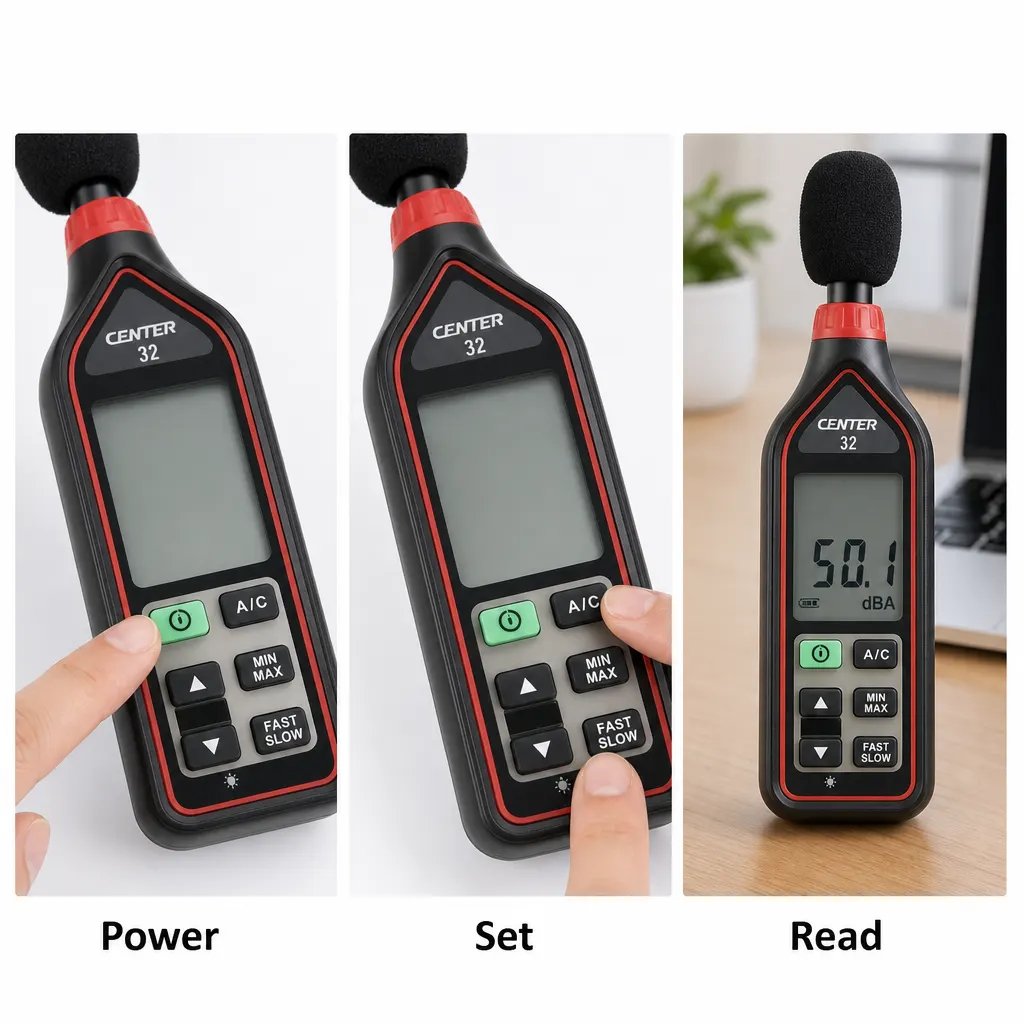
Start machinery checks with a repeatable reading plan

For noise meter for machinery checks, begin with a repeatable plan rather than chasing the highest number. Choose a fixed position, note the machine and its operating condition, take readings at an agreed time, and record the location, activity, duration and anything that changed. Compare like-for-like observations to see whether a guard, closed door, relocation or altered process changes the reading. The listed CENTER-32 English Version is identified as a digital sound level meter, and its listed title states IEC 61672-1 Class 2; however, the available public product record does not provide further specifications. Treat it as a possible preliminary-check tool, not automatic proof of compliance.
This is the useful first decision for a workshop manager, facilities colleague or site supervisor: do you need a comparison between two machine conditions, or do you need an assessment that another party must rely on? A meter can be part of a structured observation, but the instrument alone cannot supply the context. Before ordering, define the question, the location, the machine state and the record you need to keep. If the result could affect a formal workplace decision, ask for the supporting documentation and consider competent specialist advice rather than presenting one displayed value as the final answer.
Choose the UK work area before choosing the meter
At a UK joinery workshop, the practical starting point might be the bench beside an extraction system, a saw or a compressor. In a warehouse, it could be the packing station near a conveyor or loading door. Choose a named place where people work and describe what was happening there: machine running or stopped, door open or closed, empty room or normal production, and whether another source was audible. Those details make the result useful to someone who was not present, rather than leaving a number without a setting or a date.
A machine check should not be built around one dramatic moment. First identify the concern: a new installation, a change in operating hours, a worker’s comment, a neighbour’s complaint, or a suspected change after maintenance. Then decide whether you are comparing locations, operating states or before-and-after controls. Keep the comparison narrow. If the saw is running for one reading and idle for the next, the difference may simply describe the activity, not the effect of a screen or enclosure. A clear plan helps the person taking readings stay consistent and gives the manager a sensible basis for the next conversation.
Check the CENTER-32 listing against the job
The product information available for this offer is narrow. It names the model as the CENTER-32 Digital Sound Level Meter, English Version, and identifies the English-version SKU as the one covered here. The listed title states IEC 61672-1 Class 2 for that offer. That is the extent of the product-specific public information supplied. There are no published specifications for measurement range, frequency weighting, time response, display behaviour, dimensions, power, data storage, calibration, environmental limits or included accessories. Those omissions do not prove the meter lacks a function; they mean you should not assume one when deciding whether it fits.
Check the listing against your actual brief line by line. If your brief simply calls for a named digital sound level meter for preliminary observations, the model identity may be clear enough to investigate further. If the brief requires a particular weighting, response, logging method, microphone arrangement, calibration status, traceability or formal reporting workflow, those points need written confirmation before you rely on the product. Also confirm that the English version is supplied; the Chinese-version SKU is excluded by the specification. A correct model name and a standard claim in a title are not substitutes for the operating and quality information your task demands.
Separate a spot reading from exposure or nuisance evidence
A reading beside a running machine describes the sound level at that place and time under those conditions. It does not, by itself, describe what a person experienced across a shift, how often the task occurred, or what happened in another room. For a workplace concern, keep the meter reading alongside the task, duration, worker location and operating pattern. For a neighbour or tenant complaint, record the date, time, activity, doors or windows, and whether other sources were present. This is not about making the record look formal; it prevents a single figure being asked to answer a question it was never designed to answer.
Do not buy this model solely because you need a legally defensible assessment, a documented exposure result or evidence for a dispute and have no route to verify the required documentation. The supplied facts do not establish calibration, independent certification, traceability, measurement settings or suitability for any particular regulatory or legal purpose. Likewise, it may be a poor match if your team cannot obtain clear instructions in English or if the task needs stored results and the listing cannot confirm that function. In those cases, pause the purchase and ask a competent occupational-noise or acoustics professional what evidence and equipment are required.
Run a like-for-like check at the workshop bench
Use this sequence at the workshop bench or machine bay. First, write the question in one sentence, such as whether closing a door changes the reading at the packing bench. Second, mark the position from which you will observe and keep it consistent. Third, note the machine, setting, material and surrounding activity. Fourth, take a reading while the stated condition is stable, then repeat the observation rather than selecting only the largest value. Fifth, repeat under the comparison condition. Finally, record the time, duration, location, reading and any interruption. The sequence turns an impression into a comparison without pretending it is a full assessment.
When machinery cycles or fluctuates, describe the cycle instead of hiding it behind one number. Note whether the sound rose during start-up, cutting, extraction, loading or shutdown, and say how long that part lasted. If a control is being tested, change one thing at a time where practical: close the door, move the bench or alter the process, then repeat the same observation. Do not compare a quiet preparation period with a busy production run. If people are exposed for different lengths of time, keep those timings visible in the record and escalate questions about exposure rather than calculating a conclusion from a spot reading.
Use this buying checklist for the English-version SKU
Use this buying checklist before selecting a noise meter for machinery checks. Identity: does the offer say CENTER-32 Digital Sound Level Meter, English Version, and is the English-version SKU the one being ordered? Claimed standard: is the wording IEC 61672-1 Class 2 clearly tied to this offer, and can the seller provide supporting documentation before you rely on it? Size and placement: are the dimensions, microphone position and any stand or mounting details documented? Setup: are English instructions and the required operating steps supplied? Content: are the meter, power items and any accessories listed? Environment and aftercare: are operating limits, calibration guidance and maintenance details stated? If a line is unanswered, mark it as unknown rather than filling the gap with an assumption.
The checklist also tests whether the product can fit the record you need. Ask how readings are viewed, whether they can be retained, and what information you would need to copy into your log; the supplied facts do not confirm display controls or storage. Ask what calibration information accompanies the exact unit and how often checks should be made, without assuming that an answer exists. Finally, write down the intended setting—joinery shop, packing bench, plant room or another named area—and the decision the reading will inform. A meter chosen for a clearly limited comparison is easier to judge than one bought with an undefined promise to cover every noise question.
Spot the mismatch before you order
The most important mismatch is between a preliminary comparison and a formal result. If a health-and-safety decision depends on personal exposure over a working period, a single machine-side observation is not enough information. If a neighbour dispute depends on nuisance at particular times, readings from an unrelated production period may not answer it. If a client, regulator or court needs evidence in a specified format, the supplied product record does not confirm that this offer meets the requirement. In each case, define the required evidence first and obtain competent advice where necessary, rather than hoping a product label will close the gap.
There is also a simple version mismatch to avoid. The product information supplied for this offer identifies the English-version CENTER-32 and excludes the Chinese-version SKU. A differently described listing should not be treated as the same item without checking the model and language version. More broadly, do not choose on the words digital, sound level meter or Class 2 alone if your work depends on features that are not published here. The prudent buyer is the one who can say exactly what will be observed, what will be recorded, and what will happen if the reading suggests a larger problem.
Take a documented next step at the UK workplace
Your next step can be completed before you place an order. Take one blank record sheet to the Birmingham workshop, Leeds packing area or other named UK workplace where the concern arose. Write the machine, location, date, time, operating condition, duration and comparison you intend to make. Then list the product questions still open: dimensions, setup, contents, environment, aftercare, calibration and any required measurement settings. Ask the seller to answer those points for the exact CENTER-32 English-version SKU and to support the listed IEC 61672-1 Class 2 wording. This gives you a clear yes, no or seek-advice decision instead of an impulse purchase.
If the answers match a limited, preliminary checking job, use the same record plan when the meter arrives and keep observations tied to conditions. If the answers do not cover the requirement, stop there; a missing specification is a reason to investigate, not a reason to invent capability. Share the record with the responsible manager or safety adviser, especially where people spend long periods near the machinery or where a complaint may become a formal matter. The useful outcome is not the biggest decibel figure. It is a clear account of what was checked, what remains uncertain and what action should follow.